"I have observed that all students enter this space of becoming-other for emergence to
happen but the intensity of the liminal varies and does not continue evenly throughout
the research. It is about entering a particular space of creation. There are times
of transformation and times of stability in the research, as in life." ( Post modern emergence Somerville 2007)
Its hard coming back having been away. Today I woke up and wondered if I was heading in the best direction. As Somerville points out there are times of stability and times of transformation. When I got back from Venice airport her post modern emergence article was open on my desktop. I have read it before and remembered this only as she talks of being "in country" as it had triggered an early memory of watching Nicholas Roeg's brilliant film walkabout as a teenager. The film seems to revolve around cultural difference and abandonment of both responsibility and self in the harshness of the Australian outback. I jump to an image of the global weather forecast on sky TV and the realisation I had that Alice Springs is bang in the middle of the country and just under 40 degrees C which was the temperature of the Finnish Sauna I spent most evenings in last week. I jump again to Neville Shutes book A Town like Alice I glimpse the film in the corner of my minds eye. To the Australian mechanics punishment beating at the hands of the Japanese guards. Then the thing I always think about when I remember Neville Shute and my grandma's friend who died on the maiden voyage of the R101 airship to America. Shute had helped to design this when he was balancing a career as a writer and as an aviation engineer. This is all going on in my head as I bounce around in an attempt to settle on what I am going to say tomorrow at my supervision meeting.
Today I have transcribed my final meeting with Abi about our work together. I have an idea I want to write a chapter about this project which is almost standalone with the title "What I learnt from working with Abi' It is an interesting transcription but hard to pull any headline ideas from. I say a lot of 'and and and I think think think' I struggle to find words to explain what I'm thinking. There is an acceptance that at the start of the work I was making assumptions about how doing a PhD would be different to normal and a real struggle for this, difference to normal, not been about 'becoming other' which is probably where the Sommerville article materilised from on my desktop. We both come across as thoughtful and a little bit resolved to the partial failure of our shared exhibition. There is a long discussion of whether we could of done things differently and if we could of approached the exhibition much more as a co-production process with the children and parents from the playgroup. There is an interesting bit about agency and roles. I say that I think or thought my role is to intervene in what is happening - if it wasn't why would I be there? Abi seems to recognise a deep commitment to what is happening in the site that is not part of us being there, perhaps an ethnographic eye if not an ethnographic distance. It is not a good interview in many ways, I talk too much but then it is also a shared reflective space and the three interviews together hold some interesting ideas and points to launch off from. I am not sure if I did a good job of this project, it feels like a clash of the old and the new, it feels complicated, it feels impossible to draw research from it that could fit into a form of writing that I could perform for my PhD thesis. It is messy and tied into all sorts of things that are bigger than my research project. It has an edge now, on paper at least it is finished, perhaps this edge will be useful and I can learn about edges. Territory is a real problem at the moment - it is the at the heart of what it is to know. Archimedes is supposed to have said that given a lever long enough and a place to stand he would move the earth. I think it is the place to stand that is the difficult thing to find especially when it seems necessary to always be in the middle of things.
My other thing today is reading Bellacasa's Matters of Care. I bought it as I imagined it would be useful to see how a new materialist approach could be brought to a subject- in this case care. Its pretty good but also a shock to the system after having a lovely week off in Italy. I'm half way through the second chapter. She writes of assembling- neglected- things and does reference Heidegger which seems to be important when we talk of things rather than objects. I feel a bit like I need to settle down a bit and work out what new materialism is doing here, its reasonably theoretical and is doing well to build without being methodical. I keep forgetting why I'm reading it though and wonder if I need to use it as a way to think through new materialism and play. But this feels like it is too linear for me at the moment. What I felt I had suggested in my revisions on the RD2 perhaps but not really where I can see useful stuff happening.
I really want to enter a time of stability as I want to get past the feelings of not quite knowing what I'm doing. If I had my confident head on I would say the stability would come from working in the field. My work with Abi and my work at the playground is thoughtful and helping me grow. There is a disjuncture between the philosophy or perhaps theory and the actions- I was hoping this might be some sort of useful agentile cut and Barad was helping me with this. I'm overwhelmed today - I have tried to start off to quickly and need to stop bouncing around through air ships and walkabouts and crises of confidence - I may now go watch a Tchaikovsky film I recorded last night so I can take a breath. Sometimes the first thing you need to do is recognise you are lost before you can find where you are.
Monday, February 24, 2020
Thursday, February 6, 2020
In the Darkness
It feels like a busy week. I have not really thought about Blogging this week but I've just written my field notes from a day at the playground on Monday and thought it might be good to drop in a sample here . It is a bit stream of consciousness but it is a marker of where I am and holds an aspect of flow that felt absent to actually doing the work.
This day was a point of slippage – a
getting down to something physical and manual that felt like real work and a
catching up with the real outputs from my ACE proposal- the making of art or at
least testing out for an experience and the idea that I was in residence- to
make something that felt like art. The line of the PhD
study and the line of practice seems to diverge since Christmas.
At the back of this was a feeling I had
moved on somewhere in understanding Bergson and time – he says that
subjectivity is made of time rather than existing within it. This made me think about how music only exist
in time as it can’t exist in a moment – I had never really applied this way of
thinking to subjectivity but it felt like I had moved somewhere into a life
more examined. I made a film ages ago as part of my blog I suggested theory playing in the background – inspired from a Laural and Hardy way out west a
film a projection
I was to dance in front of. Now I feel that an ontological approach doesn’t
work like that – theory is not located in a territory it is the plane of
consistency. I have what is philosophy -chapter
7 and I have assemblage – I also have an understanding of what the Nomadic War
machine is and I think that perhaps this
is where the PhD sits if I can work these three concepts from D and G into the
work at the playground – with a nod to lines of flight I will have a textual
plane for something interesting to emerge – I may need to wrap it all up in
something else but I can’t be doing with to much vitalism or new materialism that
feels pseudo-spiritual – it is starting to do my head in.
What a lot of stuff to carry into the
playground – as we start to dig out concrete and remove old equipment. The just getting started feels like a really
good move – there is something about just changing a space that opens up all
sorts of potentials. The area for loose
parts has moved under the trees at the back of the building. Stuff is gathering there we are testing stuff
out – the building of a container and a platform down the other end is feeling
less likely. Peter said the kids don’t
really go down there we thought about building an iconic swing. Also Giz had the idea it would be good for a
water slide – the potential opens up as we clear the space.
There was lots of banter – it felt male and
familiar. Digging out the old equipment
was a nightmare it had been fixed with mechanical machinery and was around 1
meter deep it took most of our time to remove one piece of it but somehow this
felt fine – it was a mission. We talked about past missions of digging out
tree stumps. Patrick told us about how
Peter had gone into an old coffin when he was a gravedigger and it had
traumatized him and he had had to have time off work, we all laughed. The time of the day folded and we were a bit
cold. I moved a large pipe and we turned
it into a tunnel, I worried about my back and my wrists – work like this is
almost like an addiction – like smoking- you really fancy a fag but it never
quite does what you want or expect it to do. It does something else.
This work is really part of been in
residence at the playground, it is not about building relationships for the
future or earning respect it is more about been present and connected. The three points of my brain are all
conflicted. The doing the work that I enjoy and would do as a volunteer, the
trying to be an artists to produce or shape what art can be and what art does
and now on top of that the artist philosopher social scientist looking for what
Erin Manning would call “A Way’ within research. The complex sets of flows going on are the
same as go on all the time although I used to be less aware of them. Digging and building are parts of dwelling
and residency is a form of dwelling. My thinking is bitty and fragmented but I
don’t think a new materialist approach will do – the assemblage is the only
thing that can hold most of this together.
We talked about a lot of stuff over the day – going to Eastborne to the
national play conference – I think Giz and Patrick talked about their mums.
Art had nothing to do with the work – we were not making or doing art so
the quick switch as I noticed the failing light was strange.
I went from helping to remove the giant
post that was well stuck in the ground to thinking about making something that
looked like art. On my own I put a
screen up then I flew Aiw Wai Wai Flag for refugees – I had forgotten that
bit. Me Giz and Patrick erected the
screen to look a bit like a sail on the pirate ship. It was all a bit of a rush. I remember in the moment of setting this
up for a projection I felt stupid as somehow the thoughts and things that would
legitimate the effort felt out of reach.
In the 7 years I’ve had the projector I think it was the first time I
had tried something out for my “own” work and even this was to get a photograph
for a n article in Now Then magazine – projecting the past onto the present which is
very Bergson in a literal way. This
moment of conflicting drivers which is actually obviously a fulcrum of the work
was really underpinned by feeling a bit stupid – A lot of effort to achieve .......I’m
not sure what? Its almost like in the
realization of something that is my idea – old photos on the site – captain
flint from Blacksails – meeting my ACE audience figures – helping Anton feel
useful – there is a collision and perhaps this is a word that needs drawing in
more centrally to the notion of assemblage.
Even assengerment with its
primal energy that vibrates feels more organized than the collision of the
assemblage of what takes place. The idea that the nomadic war machine is the
thing that holds this plane together seems so removed from anything I could
explain to anybody except Tim means that it has to be thought of as what is in
and what is out – the line of flight from the assemblage – and this is perhaps
the trick to understand the notion of Deleuzian territory. Anyway we set up I projected old photos of
the playground – took a picture for Now Then article then projected the scene
of captain Flint from Blacksails the whole series moved to this point for me –
the lesson that we are kept in our place because we fear to enter the darkness
– we are frightened by the potential of an alternative way of been in the
world. It is a Marxist reference to
revolution and fits the thread of my work about the fear of things been
different – I am slightly embarrassed that I am doing this work – everyone
liked it and it is part of my arts council work and I am been paid to do it and
the behavior is what is expected of me.
What I think though is that to do this kind of work requires a closeness
to the chaos just before the crest of a wave the build up to the crash and
collapse and that there is a problem with linear knowing that means the sea is
always calm. The intersection between
practice and research is an intersected – it is like a cross fade or a
transition where things blend together that extends in both directions and the
point where it is neither one nor the other is the interesting phase of the
transition. I feel under pressure to be
either one thing or the other because it makes things easier – it steers us
away from the darkness.
A set of messy random thoughts from a messy random day - it feels good to be doing work that feels like work again
Monday, January 27, 2020
Play trip to London
Friedrich Frobels gifts were design for Kindergartens or children's gardens they were all a little prescriptive and involved making patterns but I would love to have some for my shelves. I visited the exhibition "Play well " at the Welcome center on Wednesday I also went to Tate modern to see the the work of Nam June Paik a Korean artist who navigated the edges of Fluxes and had worked with Jon Cage and Joseph Beuys before they were famous.
The play exhibition had a lot of art in it and the art exhibition had a lot of play in it, in some ways this felt good but it also made me wonder where I fitted in the mix. I suppose I am an artist who is interested in play and my main interest is in making art. Nam June Paik had fastened musical instruments to strings and dragged them around to make noises and it made me think of my exhibition of things on strings.
I had not really been thinking of art references but I had remembered a Gordon Matte Clark piece where he had walked around New York with a large magnet on a string and collected bits of random metal. I like Fluxus works especially the idea of the score and the introduction of the accident and some of Brecht's ideas on intermediality The thing about this kind of artistic backdrop is you find more meat in it if it remains a little bit of mythological history - the more you look into it especially beyond the works the less useful it becomes. The shorthand of history allows it to go somewhere new, be reworked rather than pinned down. Fluxus always seems to have an edge of ego and control that I'm not that sure about. The accidents feel contained and authored the artists hold on to their subjective position. Art history is a well for artists, sometimes the water is father away than the length of the bucket rope, sometimes the well is dry and sometimes the water has gone bad but it is always a well.
Philosophy or maybe theory if we like doesn't work like a well it works like a map of where to find a well or perhaps instructions of how to dig one. I read about 50 pages of Barads Meeting the Universe Half Way on the train. I have to say it was very good and I found it much easier to take seriously than Bennets Vibrant Matter. I'm on a journey into new materialism to find an area where I can talk and not feel like an idiot. Its making me feel a little bit uncomfortable as there is something essentially against the grain for me. Some of this may be being a privileged white man, some of it may be a life long commitment to humanism and trying to be a good human. I am resistant to the dissolution of the subjective, it sometimes feels like just a mind game, a trick of positioning. I secretly think that the conflict may not be the theory as much as the way it clashes with how we imagine art, how art can be speculative. I know that for lots of the theorists this is a problem easily worked through, we can still have our subjective agency but it doesn't take priority over everything else. When you try to be an artist the drive to realise your ideas becomes a big part of who you are. The motivation for the work, the priority, is to hold it together against multiple forces, a subjective dispersed across ecologies is difficult.
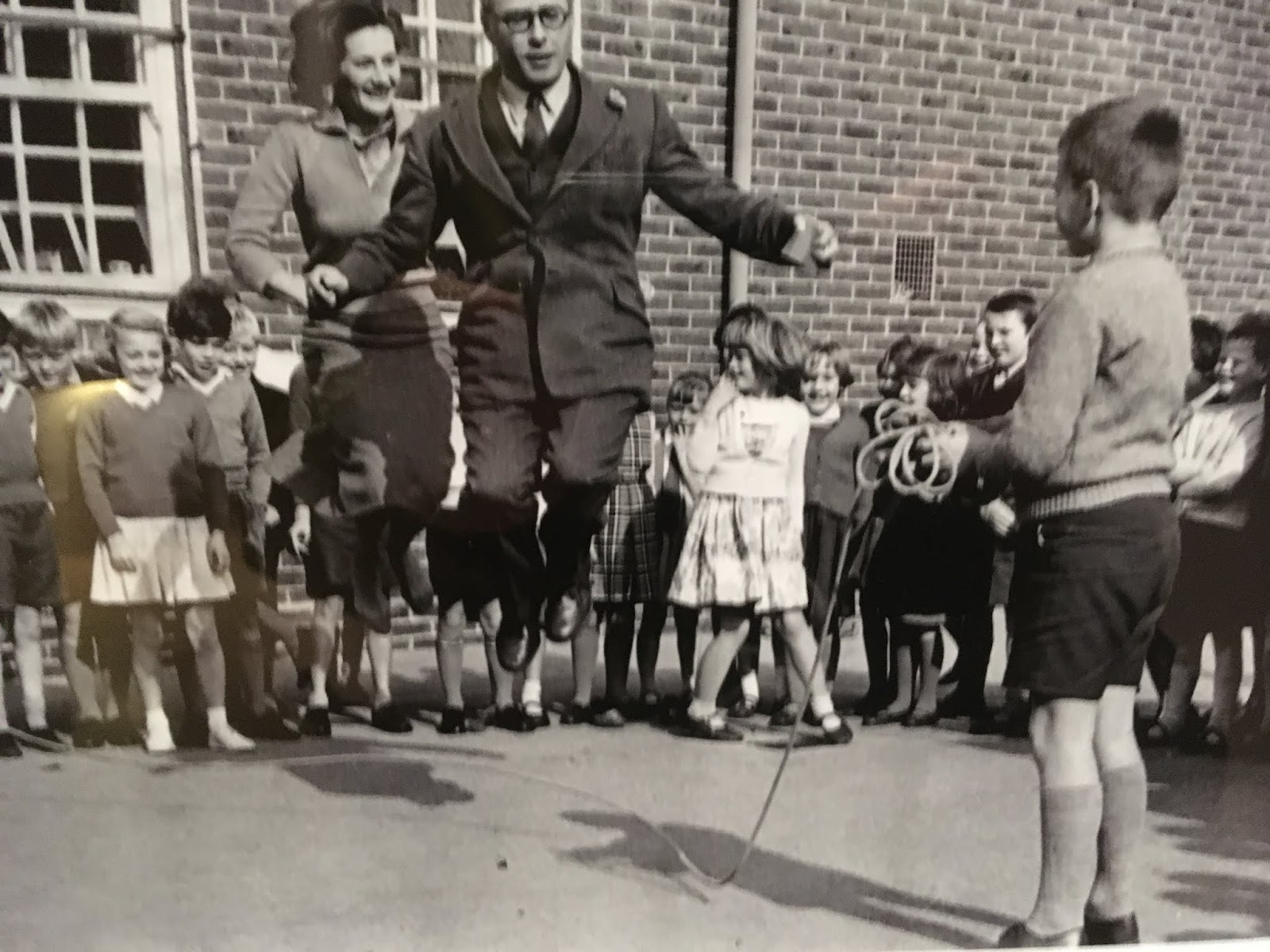
This is an image of the Opies skipping in a school. I really liked the play exhibition- it wasn't very academic but it did remind me how little I know about play and the play movement. There was a limited amount about adventure play but a great film of Lady Allen it was nice to see her in the flesh. She talked about building 500 playgrounds withing 5 years after the war, it made me feel sad that they are all closing and I recognised a danger within this nostalgia. There was a brilliant film of a group of boys let loose in a gallery destroying sculptures and then rebuilding things and making dens although it actually wasn't that organised they really just smashed stuff up and then felt a bit guilty.
The artist Adam James who does lots of work about Larps had got into loose parts and made a strange sculpture that it seemed impossible to do anything with. This said the enabler people were brilliant and loads of people were having a good go to build mini Stonehenge. My reflection was although he talked about Loose parts theory he hadn't really taken it on board. I have read the short piece by Nicholson and like the chapter in Anarchy in action by Colin Ward there is a definite lack of content in these texts. They talk of different times and different worlds and I really do like them but they don't lay things out very clearly rather they put the issues at hand central.
Writing this jumble I wonder if I'm getting distracted again I'm certainly working and reading and not doing anything else other than read write think and look but it feels a bit tractionless again, like a big tank stuck in the mud - that's a reference to Deleuze and Guattari's war machine now - last year it would of been a metaphor about feeling stuck.
Thursday, January 16, 2020
assemblage
I have passed my RD2 progression and I am still not past it. I have lots going on and I have recognised that to an extent the RD2 process had made me withdraw from things. I have three ideas and they are quite short.
1. Art helps us keep on the edge of chaos it helps us to stay on the edge of anything that makes sense.
2. This keeping on the edge of chaos is maintained by a consistency of practice - what I have started calling the secret plan. It is a plan that is secret from everyone it is in the background like the space behind your head - you have an idea it is there but are not sure what it is.
3. I get sad when I can't get my life to fit the secret plan of practice my plan is very flexible but it is not shatterproof.
Aspects of doing a PhD can't bend to fit my secret plan and this has messed with my melon and left me feeling a bit lopsided. I am waiting for the feeling to lift as I'm not sure what I need to do to make it go away. Underlying the last few days has being a minor guilt that I'm not doing any work. I have been really busy and read and thought a lot and had meetings. I have started to think about writing my literature review about loose parts play and their affordance. I have read quite a bit and its been useful. My problem is that I'm been drawn into play theory when I think I want to work with art theory. Perhaps it is these two phases or modes of assemblage that I need to weave together in the literature review through aesthetics. This was what was in my first RD2 before had my wings clipped perhaps I need to get a little bit of this out of my system as it did fit my secret plan. I know it wasn't a PhD though so perhaps I should do something else.
Monday, January 13, 2020
And now this is me.
I took this picture just before Christmas. I took it with the intention of writing a blog post about measurement and the fact I need to remind myself to be shatter resistant. I moved the pan scrub in the sink to improve the composition. I only mention this as Abi had noticed me repositioning children's tissue paper on sheets I was laminating while saying " That's perfect, brilliant" to the kids. Whether this is aesthetic OCD or my Faux-Bauhaus artistic training it has always seemed important that things are positioned properly. That they hold their weight and composition.
I am not shatter resistant; I feel shattered, stretched, strung out - as Bilbo the Hobbit says, 'like butter spread too thin'. At least I remembered I had moved the pan scrub, I noticed my action and chose to ignore it. I have discovered that the moving of the pan scrub is a distraction. Someone could probably write a pointless study about where it should go and somehow link it to the new materialism through assemblage theory but you need to ask yourself why would ya and what would it do.
The RD2 is passed; I got some interesting feedback and I have a focus. The rulers in the sink were going to point towards measurement. I was going to say that the ruler is an instrument of measurement that works and changes neither what it measures or itself. The point was that having read lots of new materialism that was referencing the quantum world and quantum measurements and uncertainty principle, I wanted to try to say that on some scales a ruler is fine especially if you want to know how long a piece of string is. This is my first problem - I need to get past it.
This all seems a bit pointless today. I drank champagne on Friday to celebrate getting through my RD2 and then finished Deleuze and Guattari's What is Philosophy? this morning. I have then been reading adventure play literature about loose parts play for the rest of the day and writing an abstract for a conference in Finland. It all feels not quite right, like I'm a wannabe play-worker/academic/artist. What I want to be is an artist who is interested in thinking differently about the world as I have run out of rope to hang myself with.
I have now got to do three reminders. The first is that in What Is Philosophy chapter seven, D and G explain that art does not sit on the same plane as science or philosophy it sits in a world of sensation - the aesthetic realm. They are very clear about this and they are clear about the mind being a point where the plane of science (what can be measured and find a center through the forces that hold it) and philosophy (that which establishes concepts on an unfolding plane of immanence) and art meet. I liked this book and I think that it makes sense of things. There is a bit where they say that drugs as substances are flaky so the thinking or ideas or art that emerge from taking drugs must also be flaky. I loved this bit partly because it is so stupid and also partly because I had reached the point when I read it that I considered it to be true. In the conclusion there seems to be an intimation that they had lost their edge and even that some of the thoughts they had had were losing their coherence as if they had built something bigger than their current selves; they were old with decaying minds, only a few years from not being able to resist jumping from the open window.
Laura and Kate have asked me to start to write my literature review when I'm not under pressure. Something to share at our next supervision. The RD2 process let me know that there is an ordering at hand and for all the investment in an ontological turn there is a certain amount of stamp collecting that needs to take place. I think I have started this today I am reading some nice stuff about adventure play. I am taking a new materialist line of sight and avoiding a line of flight but I wonder what this means. I don't know why the Paul Anderson film about the dress maker was called The Phantom Thread, but that is what it feels like today - chasing a phantom. There is a scene where Daniel Day-Lewis knowingly eats the poison mushrooms his lover collects and cooks - she says, "I want you flat on your back, helpless, tender open.......you need to settle down a little." This is what it feels like today.
Thursday, January 2, 2020
New Year New Materialism
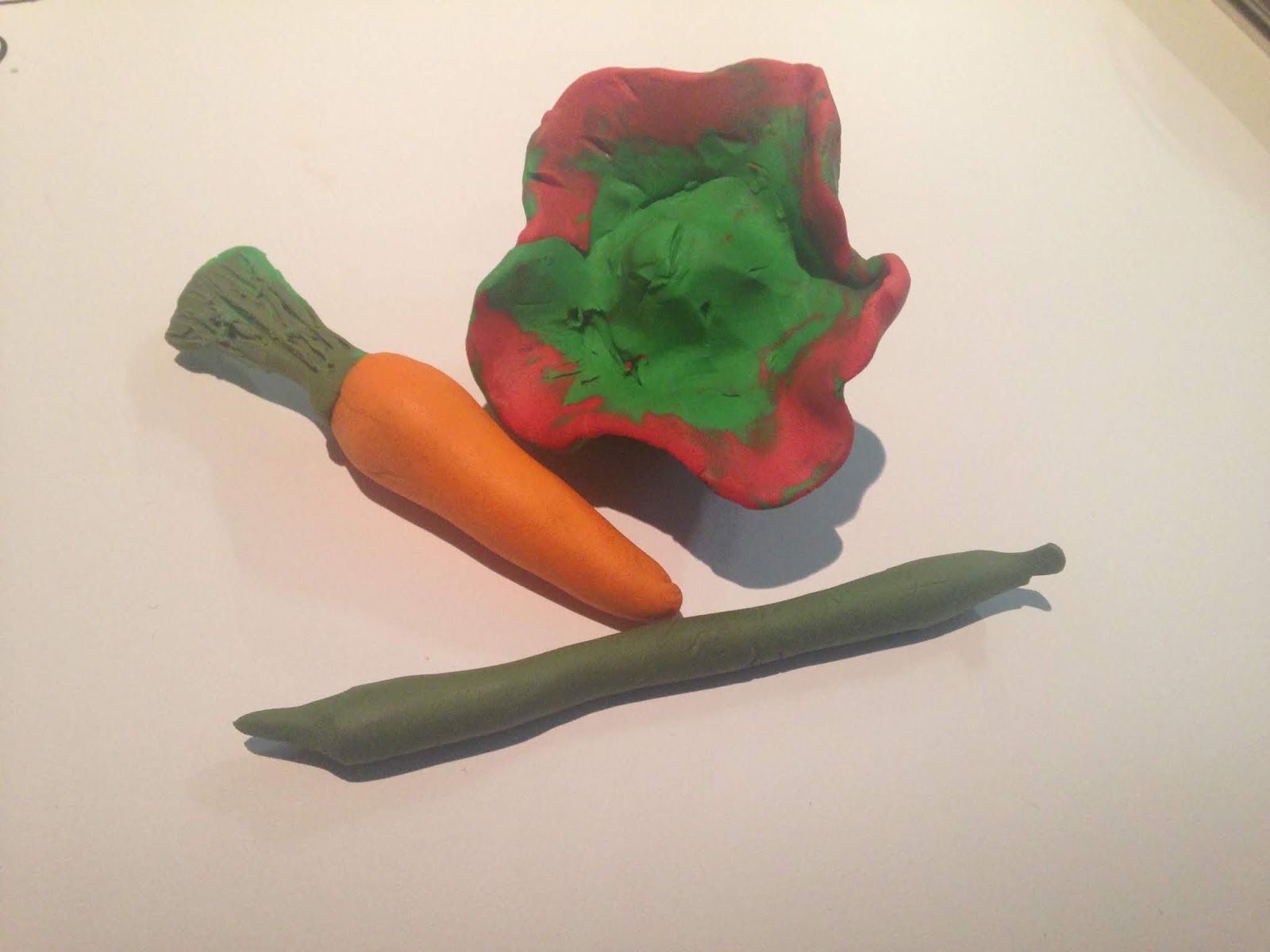
I made these out of plastercine at a sleepover at the science museum in London a couple of years ago. It was a strange event, Richard Wentworth was there doing a talk, he was very good, he is an old school artist and a good art reference when we talk of materialism. I especially like the green bean but Lollo Roso is not an easy thing to make or model, some things are easier to represent than others.
A few years ago I wondered why the figures at Madame Tussourds are not considered as super-real sculptures. I know they have their own tradition yet they are striving to represent the reality of a human, even if only from the outside. I don't know if anyone has written about it and for my blog I don't really care. There seems to be something in the negative or difference, the "not art" that might help us understand what art is. What is it about Wax works that means they are not art ? On Wikipedia it suggest that they are not art as they are not intended to be art and this makes them popular visitor attractions, perhaps this is why the fairground was a home for the early moving image as spectacle and ahy many art cinemas are empty. When I went to see Francois Massarto a couple of years ago he suggested that the term artist was a problem and perhaps we all needed move on; it was what Jessica Gullion would describe as a Zombie category. I still feel a bit niggled by this, I can see his point but behind being a dad and a husband it sometimes feels like I need the label. Nobody says firefighters or mechanics should not carry their labels within their job descriptions. Perhaps Francois point is that artists are like firefighters but all the fires have gone out. Perhaps that firefighters now do much more than fight fires so the label is confusing and outdated. I like being an artist because it is wild, undefined and is as Sartre would suggest it helps to live a life not as an object, to position existence before essence.
We are now here and here is where we are. I have just sent Kate a new draft of my RD2 which I seem to have been going on about for ages. It did seriously let get under my skin. I have learnt a few major lessons from this process and they will be helpful for the next couple of years so I put them here to remind myself.
1. In the end I am doing a PhD and although I can mess with the edges I need to make what I write into something that can be marked as a PhD.
2. The conception of knowledge at the university is not like outside the university. It is faith based in that it believes in itself.
3. This is not an opportunity to be honest or to perform - the path is somewhere in the middle.
4. Everything you read you forget.
5. It is easier to represent a green bean than Lollo Rosso sometimes the best thing to do is take the easy option.
6. The best writing, like the best walks ends up where it sets off . Dad doesn't always have to run back to get the car.
Tuesday, December 17, 2019
What happens when you realise you are not Francis Bacon or Gilles Deleuze?
Me and Kate did a keynote yesterday about creative methods - its the fourth talk on methods I've done in 6 weeks. We were talking about our Fishing as Wisdom project, I decided to explain Carlos who is in the image above. His origins lie in my artistic belief that during the 1970's technology, in the modernist sense of progression, was still full of the potential for good. Cine cameras were used to record a baby's first steps or a wedding, the idea of video surveillance was a Science Fiction fan's dream. Carlos and his tripod are from the 1970's; apart from his ears that were purchased from the Scarborough based company Harmony Supplies who sell equipment for Chinese medicine and were the only company I could find who supply a left and a right ear to practice acupuncture on. The head has a tea towel soaked in plaster of Paris inside to try and simulate the density of a human brain/head/mind. The ears have some plastic tube used in home brew connected inside which is sealed at one end and contains a specific amount of air designed to give back pressure similar to a human ear drum. Binaural recording uses the two channels of a stereo sound recorder to capture the sound as close to the point where a human would hear it. When played back through headphones it gives a sense of the space of sound. It is a bit like surround-sound in your head - you can judge space and movement. I used Binaural sound as a homage to one of my favorite artists Janet Cardiff but also because it's a way of recording that pays attention to space.
When fishing I noticed that one ear attunes to the outside, to the noise of the water and nature, and the other attunes to what people are saying or to conversation. The sounds come from different sources; the space is open on one side and intimate on the other. The head bought from Ebay has the name Carlos written on the back; it is his brand name. Carlos was a recording device and he also became the symbol for art in the project. I struggled to explain this in the talk: I intended to show the film with its Binaural sound but the equipment was working on a single channel. The sound cut off due to a technical issue half way through the clip. It didn't seem to matter. Carlos and Binaural sound are probably best left in the margins, they were never meant to take centre ground.
In my RD2 progression meeting we had a long discussion about how to make arts practice and writing work together. I said lots of it is none linguistic but this isn't a good enough answer in the context of a PhD, it doesn't move us forward. My description of Carlos is not like Deleuze talking us through Francis Bacon's painting, it is not on the same plane of immanence. However hard we try it will not fold in. I'm happy with that as I think that failure is something that carries its own momentum. I don't think practice can always align well with words. Words can struggle towards meaning and practice can maintain itself in a place of whimsy on the edge of meaning; they are chalk and cheese or chalky cheese. In a way, Carlos is art like Francis Bacon's paintings are art - Carlos points to more than he is, more than he can ever be; he is art and in a way he is change and movement. Carlos fails in reality as art, as device, as recording machine. He fails to ask the questions that need to be asked, he is a silent witness who does not bear witness as I had intended. It is impossible to articulate what Carlos does, that is why he can still represent art an intentional object with no intention. He lives in a cupboard in my studio - the cupboard is called Mick, it is named after a cupboard in my Grandad's garage which was called Mick - he would name his cupboards to help us find things.
Subscribe to:
Posts (Atom)