Monday, January 27, 2020
Play trip to London
Friedrich Frobels gifts were design for Kindergartens or children's gardens they were all a little prescriptive and involved making patterns but I would love to have some for my shelves. I visited the exhibition "Play well " at the Welcome center on Wednesday I also went to Tate modern to see the the work of Nam June Paik a Korean artist who navigated the edges of Fluxes and had worked with Jon Cage and Joseph Beuys before they were famous.
The play exhibition had a lot of art in it and the art exhibition had a lot of play in it, in some ways this felt good but it also made me wonder where I fitted in the mix. I suppose I am an artist who is interested in play and my main interest is in making art. Nam June Paik had fastened musical instruments to strings and dragged them around to make noises and it made me think of my exhibition of things on strings.
I had not really been thinking of art references but I had remembered a Gordon Matte Clark piece where he had walked around New York with a large magnet on a string and collected bits of random metal. I like Fluxus works especially the idea of the score and the introduction of the accident and some of Brecht's ideas on intermediality The thing about this kind of artistic backdrop is you find more meat in it if it remains a little bit of mythological history - the more you look into it especially beyond the works the less useful it becomes. The shorthand of history allows it to go somewhere new, be reworked rather than pinned down. Fluxus always seems to have an edge of ego and control that I'm not that sure about. The accidents feel contained and authored the artists hold on to their subjective position. Art history is a well for artists, sometimes the water is father away than the length of the bucket rope, sometimes the well is dry and sometimes the water has gone bad but it is always a well.
Philosophy or maybe theory if we like doesn't work like a well it works like a map of where to find a well or perhaps instructions of how to dig one. I read about 50 pages of Barads Meeting the Universe Half Way on the train. I have to say it was very good and I found it much easier to take seriously than Bennets Vibrant Matter. I'm on a journey into new materialism to find an area where I can talk and not feel like an idiot. Its making me feel a little bit uncomfortable as there is something essentially against the grain for me. Some of this may be being a privileged white man, some of it may be a life long commitment to humanism and trying to be a good human. I am resistant to the dissolution of the subjective, it sometimes feels like just a mind game, a trick of positioning. I secretly think that the conflict may not be the theory as much as the way it clashes with how we imagine art, how art can be speculative. I know that for lots of the theorists this is a problem easily worked through, we can still have our subjective agency but it doesn't take priority over everything else. When you try to be an artist the drive to realise your ideas becomes a big part of who you are. The motivation for the work, the priority, is to hold it together against multiple forces, a subjective dispersed across ecologies is difficult.
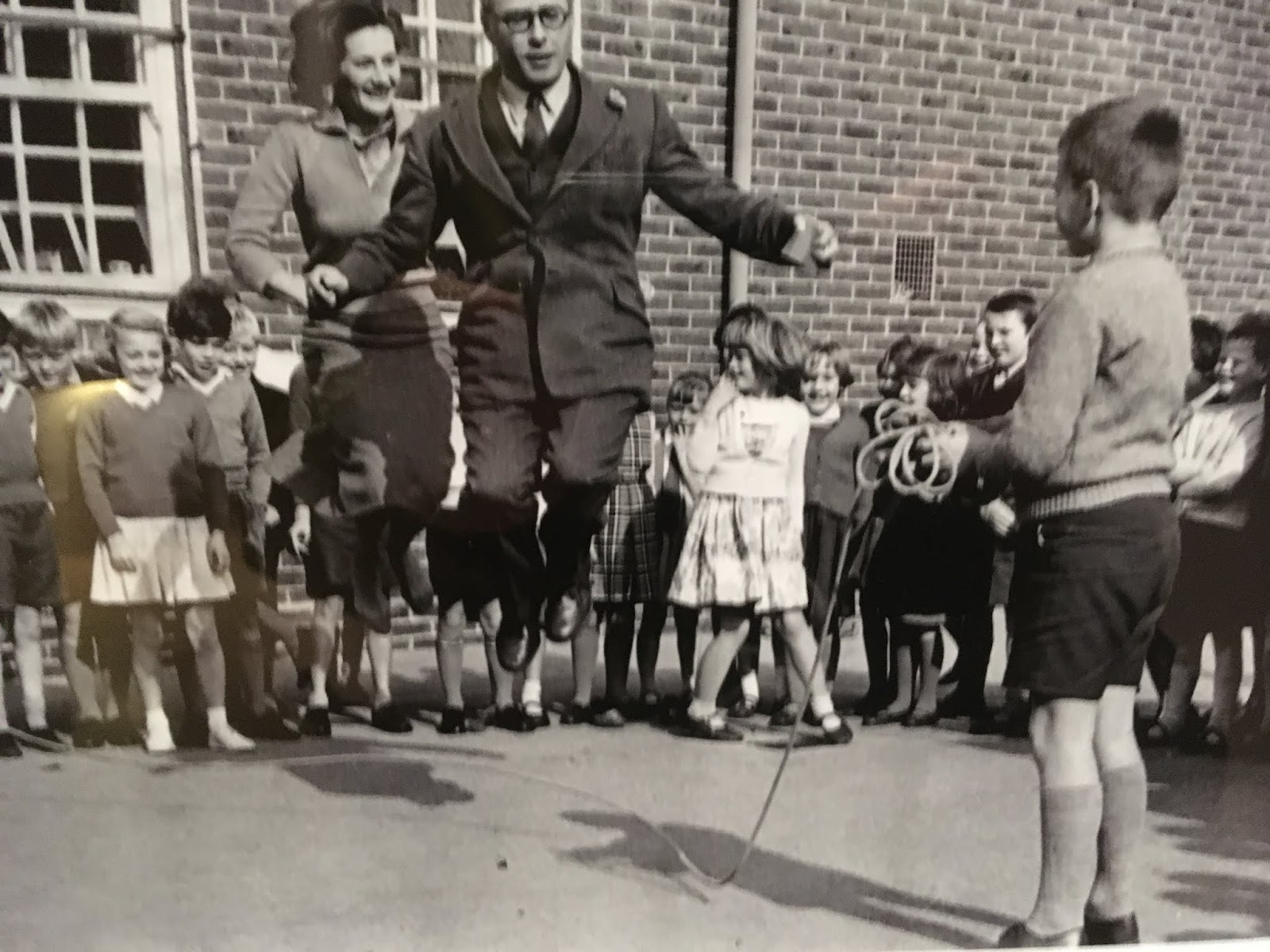
This is an image of the Opies skipping in a school. I really liked the play exhibition- it wasn't very academic but it did remind me how little I know about play and the play movement. There was a limited amount about adventure play but a great film of Lady Allen it was nice to see her in the flesh. She talked about building 500 playgrounds withing 5 years after the war, it made me feel sad that they are all closing and I recognised a danger within this nostalgia. There was a brilliant film of a group of boys let loose in a gallery destroying sculptures and then rebuilding things and making dens although it actually wasn't that organised they really just smashed stuff up and then felt a bit guilty.
The artist Adam James who does lots of work about Larps had got into loose parts and made a strange sculpture that it seemed impossible to do anything with. This said the enabler people were brilliant and loads of people were having a good go to build mini Stonehenge. My reflection was although he talked about Loose parts theory he hadn't really taken it on board. I have read the short piece by Nicholson and like the chapter in Anarchy in action by Colin Ward there is a definite lack of content in these texts. They talk of different times and different worlds and I really do like them but they don't lay things out very clearly rather they put the issues at hand central.
Writing this jumble I wonder if I'm getting distracted again I'm certainly working and reading and not doing anything else other than read write think and look but it feels a bit tractionless again, like a big tank stuck in the mud - that's a reference to Deleuze and Guattari's war machine now - last year it would of been a metaphor about feeling stuck.
Thursday, January 16, 2020
assemblage
I have passed my RD2 progression and I am still not past it. I have lots going on and I have recognised that to an extent the RD2 process had made me withdraw from things. I have three ideas and they are quite short.
1. Art helps us keep on the edge of chaos it helps us to stay on the edge of anything that makes sense.
2. This keeping on the edge of chaos is maintained by a consistency of practice - what I have started calling the secret plan. It is a plan that is secret from everyone it is in the background like the space behind your head - you have an idea it is there but are not sure what it is.
3. I get sad when I can't get my life to fit the secret plan of practice my plan is very flexible but it is not shatterproof.
Aspects of doing a PhD can't bend to fit my secret plan and this has messed with my melon and left me feeling a bit lopsided. I am waiting for the feeling to lift as I'm not sure what I need to do to make it go away. Underlying the last few days has being a minor guilt that I'm not doing any work. I have been really busy and read and thought a lot and had meetings. I have started to think about writing my literature review about loose parts play and their affordance. I have read quite a bit and its been useful. My problem is that I'm been drawn into play theory when I think I want to work with art theory. Perhaps it is these two phases or modes of assemblage that I need to weave together in the literature review through aesthetics. This was what was in my first RD2 before had my wings clipped perhaps I need to get a little bit of this out of my system as it did fit my secret plan. I know it wasn't a PhD though so perhaps I should do something else.
Monday, January 13, 2020
And now this is me.
I took this picture just before Christmas. I took it with the intention of writing a blog post about measurement and the fact I need to remind myself to be shatter resistant. I moved the pan scrub in the sink to improve the composition. I only mention this as Abi had noticed me repositioning children's tissue paper on sheets I was laminating while saying " That's perfect, brilliant" to the kids. Whether this is aesthetic OCD or my Faux-Bauhaus artistic training it has always seemed important that things are positioned properly. That they hold their weight and composition.
I am not shatter resistant; I feel shattered, stretched, strung out - as Bilbo the Hobbit says, 'like butter spread too thin'. At least I remembered I had moved the pan scrub, I noticed my action and chose to ignore it. I have discovered that the moving of the pan scrub is a distraction. Someone could probably write a pointless study about where it should go and somehow link it to the new materialism through assemblage theory but you need to ask yourself why would ya and what would it do.
The RD2 is passed; I got some interesting feedback and I have a focus. The rulers in the sink were going to point towards measurement. I was going to say that the ruler is an instrument of measurement that works and changes neither what it measures or itself. The point was that having read lots of new materialism that was referencing the quantum world and quantum measurements and uncertainty principle, I wanted to try to say that on some scales a ruler is fine especially if you want to know how long a piece of string is. This is my first problem - I need to get past it.
This all seems a bit pointless today. I drank champagne on Friday to celebrate getting through my RD2 and then finished Deleuze and Guattari's What is Philosophy? this morning. I have then been reading adventure play literature about loose parts play for the rest of the day and writing an abstract for a conference in Finland. It all feels not quite right, like I'm a wannabe play-worker/academic/artist. What I want to be is an artist who is interested in thinking differently about the world as I have run out of rope to hang myself with.
I have now got to do three reminders. The first is that in What Is Philosophy chapter seven, D and G explain that art does not sit on the same plane as science or philosophy it sits in a world of sensation - the aesthetic realm. They are very clear about this and they are clear about the mind being a point where the plane of science (what can be measured and find a center through the forces that hold it) and philosophy (that which establishes concepts on an unfolding plane of immanence) and art meet. I liked this book and I think that it makes sense of things. There is a bit where they say that drugs as substances are flaky so the thinking or ideas or art that emerge from taking drugs must also be flaky. I loved this bit partly because it is so stupid and also partly because I had reached the point when I read it that I considered it to be true. In the conclusion there seems to be an intimation that they had lost their edge and even that some of the thoughts they had had were losing their coherence as if they had built something bigger than their current selves; they were old with decaying minds, only a few years from not being able to resist jumping from the open window.
Laura and Kate have asked me to start to write my literature review when I'm not under pressure. Something to share at our next supervision. The RD2 process let me know that there is an ordering at hand and for all the investment in an ontological turn there is a certain amount of stamp collecting that needs to take place. I think I have started this today I am reading some nice stuff about adventure play. I am taking a new materialist line of sight and avoiding a line of flight but I wonder what this means. I don't know why the Paul Anderson film about the dress maker was called The Phantom Thread, but that is what it feels like today - chasing a phantom. There is a scene where Daniel Day-Lewis knowingly eats the poison mushrooms his lover collects and cooks - she says, "I want you flat on your back, helpless, tender open.......you need to settle down a little." This is what it feels like today.
Thursday, January 2, 2020
New Year New Materialism
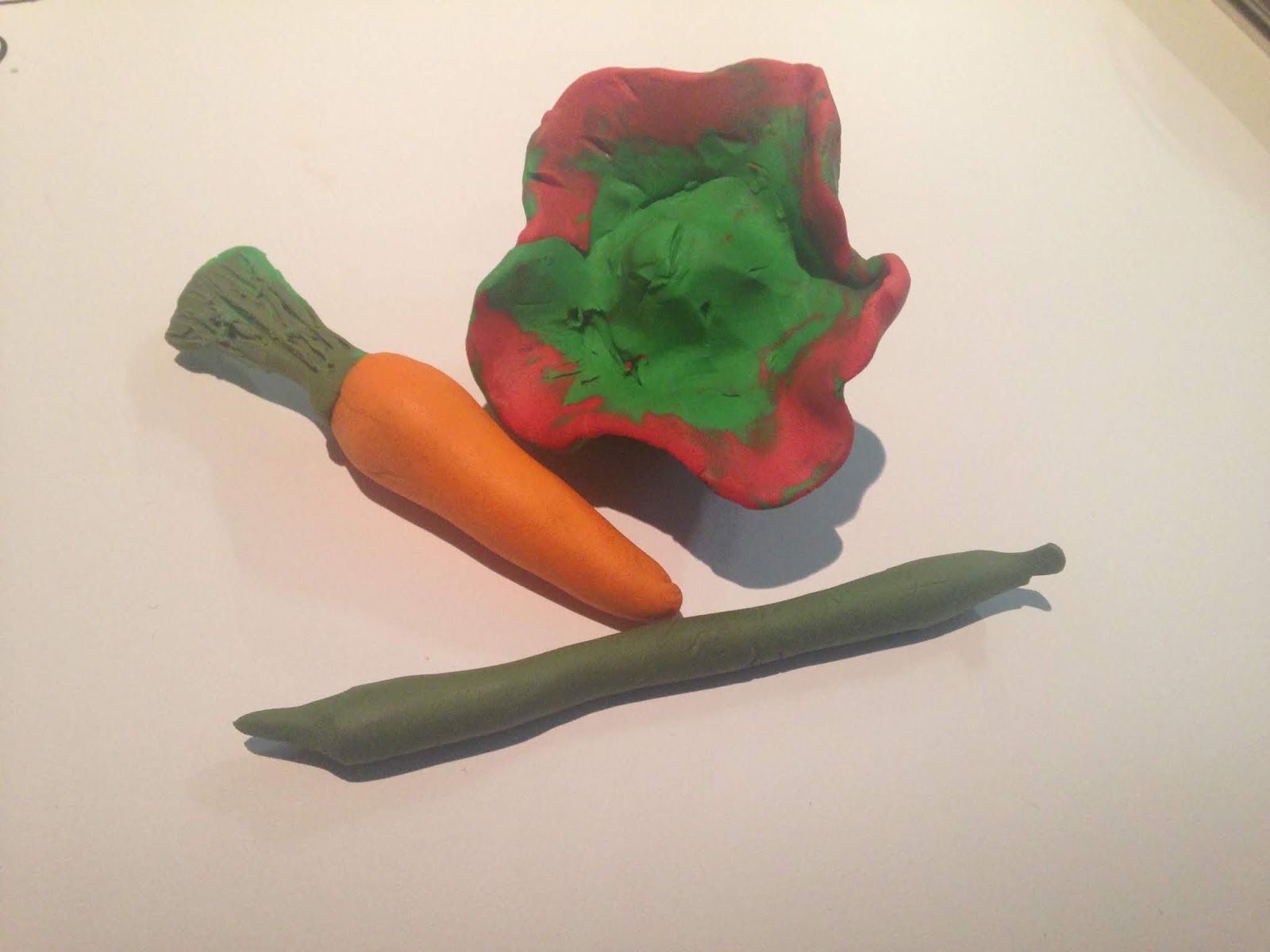
I made these out of plastercine at a sleepover at the science museum in London a couple of years ago. It was a strange event, Richard Wentworth was there doing a talk, he was very good, he is an old school artist and a good art reference when we talk of materialism. I especially like the green bean but Lollo Roso is not an easy thing to make or model, some things are easier to represent than others.
A few years ago I wondered why the figures at Madame Tussourds are not considered as super-real sculptures. I know they have their own tradition yet they are striving to represent the reality of a human, even if only from the outside. I don't know if anyone has written about it and for my blog I don't really care. There seems to be something in the negative or difference, the "not art" that might help us understand what art is. What is it about Wax works that means they are not art ? On Wikipedia it suggest that they are not art as they are not intended to be art and this makes them popular visitor attractions, perhaps this is why the fairground was a home for the early moving image as spectacle and ahy many art cinemas are empty. When I went to see Francois Massarto a couple of years ago he suggested that the term artist was a problem and perhaps we all needed move on; it was what Jessica Gullion would describe as a Zombie category. I still feel a bit niggled by this, I can see his point but behind being a dad and a husband it sometimes feels like I need the label. Nobody says firefighters or mechanics should not carry their labels within their job descriptions. Perhaps Francois point is that artists are like firefighters but all the fires have gone out. Perhaps that firefighters now do much more than fight fires so the label is confusing and outdated. I like being an artist because it is wild, undefined and is as Sartre would suggest it helps to live a life not as an object, to position existence before essence.
We are now here and here is where we are. I have just sent Kate a new draft of my RD2 which I seem to have been going on about for ages. It did seriously let get under my skin. I have learnt a few major lessons from this process and they will be helpful for the next couple of years so I put them here to remind myself.
1. In the end I am doing a PhD and although I can mess with the edges I need to make what I write into something that can be marked as a PhD.
2. The conception of knowledge at the university is not like outside the university. It is faith based in that it believes in itself.
3. This is not an opportunity to be honest or to perform - the path is somewhere in the middle.
4. Everything you read you forget.
5. It is easier to represent a green bean than Lollo Rosso sometimes the best thing to do is take the easy option.
6. The best writing, like the best walks ends up where it sets off . Dad doesn't always have to run back to get the car.
Tuesday, December 17, 2019
What happens when you realise you are not Francis Bacon or Gilles Deleuze?
Me and Kate did a keynote yesterday about creative methods - its the fourth talk on methods I've done in 6 weeks. We were talking about our Fishing as Wisdom project, I decided to explain Carlos who is in the image above. His origins lie in my artistic belief that during the 1970's technology, in the modernist sense of progression, was still full of the potential for good. Cine cameras were used to record a baby's first steps or a wedding, the idea of video surveillance was a Science Fiction fan's dream. Carlos and his tripod are from the 1970's; apart from his ears that were purchased from the Scarborough based company Harmony Supplies who sell equipment for Chinese medicine and were the only company I could find who supply a left and a right ear to practice acupuncture on. The head has a tea towel soaked in plaster of Paris inside to try and simulate the density of a human brain/head/mind. The ears have some plastic tube used in home brew connected inside which is sealed at one end and contains a specific amount of air designed to give back pressure similar to a human ear drum. Binaural recording uses the two channels of a stereo sound recorder to capture the sound as close to the point where a human would hear it. When played back through headphones it gives a sense of the space of sound. It is a bit like surround-sound in your head - you can judge space and movement. I used Binaural sound as a homage to one of my favorite artists Janet Cardiff but also because it's a way of recording that pays attention to space.
When fishing I noticed that one ear attunes to the outside, to the noise of the water and nature, and the other attunes to what people are saying or to conversation. The sounds come from different sources; the space is open on one side and intimate on the other. The head bought from Ebay has the name Carlos written on the back; it is his brand name. Carlos was a recording device and he also became the symbol for art in the project. I struggled to explain this in the talk: I intended to show the film with its Binaural sound but the equipment was working on a single channel. The sound cut off due to a technical issue half way through the clip. It didn't seem to matter. Carlos and Binaural sound are probably best left in the margins, they were never meant to take centre ground.
In my RD2 progression meeting we had a long discussion about how to make arts practice and writing work together. I said lots of it is none linguistic but this isn't a good enough answer in the context of a PhD, it doesn't move us forward. My description of Carlos is not like Deleuze talking us through Francis Bacon's painting, it is not on the same plane of immanence. However hard we try it will not fold in. I'm happy with that as I think that failure is something that carries its own momentum. I don't think practice can always align well with words. Words can struggle towards meaning and practice can maintain itself in a place of whimsy on the edge of meaning; they are chalk and cheese or chalky cheese. In a way, Carlos is art like Francis Bacon's paintings are art - Carlos points to more than he is, more than he can ever be; he is art and in a way he is change and movement. Carlos fails in reality as art, as device, as recording machine. He fails to ask the questions that need to be asked, he is a silent witness who does not bear witness as I had intended. It is impossible to articulate what Carlos does, that is why he can still represent art an intentional object with no intention. He lives in a cupboard in my studio - the cupboard is called Mick, it is named after a cupboard in my Grandad's garage which was called Mick - he would name his cupboards to help us find things.
Friday, December 6, 2019
I need the warm winds of Johan
When I first started working with Johan I would talk to him about Lacan and trilectics and spacial theory. He would talk to me about death the gap and the void - Johan taught me how to float. When I was at the sweat lodge on the new moon I prayed to the spirits and it was hot so I laid down on the earth floor which acts as a heat sink and holds its coldness. For a moment forming from the smoke I was visited by my spirit animal and without any irony it appeared as a wolf; a lone wolf. The last time I used this image in a blog the title was - The day Johan wore his wolf suit and made mischief of one kind and another. I am having my mischief squeezed out of me and this is no good thing. As nobody is reading this blog and its probably far to introspective to be of any use I will put down some notes as a marker as I prepare for next weeks mini ViVa that sounds like a mini Valet at the car wash - a surface clean.
The justification for this is that my artistic practice as a sculptor weaves in and out in an entanglement with making that involves my body, others bodies and active materials. The idea of what sculpture is and can be is not in question but it is my clear tradition, my line and linage. What this new approach excludes from the sphere of the study to an extent is the agentive qualities of what artists bring to research. At the back of the study is an inclination that the place holder that research makes for art is an abstraction and a projection and sometimes within social science research it is filled by an imaginary – so when you put an actual artist in there, things fall apart.
This I know on paper is a very loose justification for having Ruskin in my lit review, he stands for the romantic idea of the artist which persists and isn’t taken that seriously but is embodied within artists. It is part of their material or embodied self and so their potential agentive role, there vital power. See how I am trying to turn this towards a New Materialism – it is an awkward fit – well really no fit at all.
I have to now accept that I was doing a recon a butchers hook – a once over a skim or a thin slice. I was asking what is post-qualt social science research and why do we need it? I was trying to read properly but the reading was all over the place and in this all otherness I was dropping down wormholes – I was a kid in the sweaty shop of theory, deciding between 2 ounce of Yorkshire mixtures or a gobstopper.
But then when you talk to anyone outside of the very small bubble I’m floating in nobody has a clue about any of it - not even academics working in what may seems like a similar field. So my seam is too wide and it sits in a mountain side. I am digging in and have not got the energy or equipment to go up or down into what sits below or above. All this is necessary and I can already feel a shift in the level I’m working at theoretically. Yet the point is to take this into the world you need to come up from underground or dip out of the clouds Whiteheads flights of the speculative imagination seem a long time ago. My problem is not the digging into the seam it is the inability, as Geoff would say to come by - the walking back up the drift at the end of the day into the world.
I suppose I never really made a separation between theory and practice or process and product and I could, as it says in the the Hanson family song "let myself feel like when I learnt to float.'
You need to learn to float but sinking comes naturally especially if you remember to inhale. I read my RD2 this morning and I was worried it would be shit but it is in fact very good – it holds its effort and if you give it a tiny bit of space and make allowances for me it is someone’s struggle to learn to float. Floating is not treading water or swimming it is expending the least amount of energy possible to let yourself be in water.
I can see the need to focus down and the
simplest way to do this now is to take a deep dive into new materialism.
The justification for this is that my artistic practice as a sculptor weaves in and out in an entanglement with making that involves my body, others bodies and active materials. The idea of what sculpture is and can be is not in question but it is my clear tradition, my line and linage. What this new approach excludes from the sphere of the study to an extent is the agentive qualities of what artists bring to research. At the back of the study is an inclination that the place holder that research makes for art is an abstraction and a projection and sometimes within social science research it is filled by an imaginary – so when you put an actual artist in there, things fall apart.
This I know on paper is a very loose justification for having Ruskin in my lit review, he stands for the romantic idea of the artist which persists and isn’t taken that seriously but is embodied within artists. It is part of their material or embodied self and so their potential agentive role, there vital power. See how I am trying to turn this towards a New Materialism – it is an awkward fit – well really no fit at all.
I have to now accept that I was doing a recon a butchers hook – a once over a skim or a thin slice. I was asking what is post-qualt social science research and why do we need it? I was trying to read properly but the reading was all over the place and in this all otherness I was dropping down wormholes – I was a kid in the sweaty shop of theory, deciding between 2 ounce of Yorkshire mixtures or a gobstopper.
But then when you talk to anyone outside of the very small bubble I’m floating in nobody has a clue about any of it - not even academics working in what may seems like a similar field. So my seam is too wide and it sits in a mountain side. I am digging in and have not got the energy or equipment to go up or down into what sits below or above. All this is necessary and I can already feel a shift in the level I’m working at theoretically. Yet the point is to take this into the world you need to come up from underground or dip out of the clouds Whiteheads flights of the speculative imagination seem a long time ago. My problem is not the digging into the seam it is the inability, as Geoff would say to come by - the walking back up the drift at the end of the day into the world.
I suppose I never really made a separation between theory and practice or process and product and I could, as it says in the the Hanson family song "let myself feel like when I learnt to float.'
You need to learn to float but sinking comes naturally especially if you remember to inhale. I read my RD2 this morning and I was worried it would be shit but it is in fact very good – it holds its effort and if you give it a tiny bit of space and make allowances for me it is someone’s struggle to learn to float. Floating is not treading water or swimming it is expending the least amount of energy possible to let yourself be in water.
I think I can address the comments on the
Rd2 document and keep a strong sense of the things that are quite good about
it, some of its struggle. I have a lot
to do though I need to build a platform where loose parts transcend themselves
become vibrant and glow in a flat ontology where I am their equal – I also need
to spin a yarn that goes from here to there and enter back into the worked out coal seam.
Monday, December 2, 2019
In defence of R2 D2
I have finished most of my work and after a week of restless nights and a grinding of teeth I have started to feel better about the RD2 process.
Strangely this feeling better has come from the same kind of thinking too deeply that put me here in the first place. Deeply here does not mean productively as I have being flitting around in the realm of theory like a fly on scatological shit. Or perhaps more poetically some sort of insect pollinator traversing a meadow of wild flowers. Although I think I have been producing tins of artists shit rather than the Bill Woodrows bee keeper honey. I thought it may be good to reference artists work here as it is another strand of the useful process of defending my RD2. Art has it's traditions and its foundations and interestingly in creating hyperlinks the mind and the clicking tends to stop at the specific work; they are points on a map. The flight of the speculative imagination is held in the image, they stand in for more than what they are, without representing what they are, at least that is for us artists.
I have ended up at a cross roads and feel like I need to quote Ruskin - he is in my PhD for this reason as he was a great thinker who to an extent understood the artists of his day. Better I think than Deleuze or Lacan as they created art and the artist in the image of their own desire or drive, the artists of the gap and the void. Ruskin gives us the artists in full flight, in the lofty mountains of the alps or the cold Gothic beauty of a Northern cathedral .
‘And
nothing is ever taken seriously or as it is meant but
always, if it may be, turned the wrong way, and misunderstood; and while this
is so, there is not, nor cannot be, any hope of achievement of high things; men
dare not open their hearts to us, if we are to broil them on a thorn-fire.’
John Ruskin Modern
Painters, Volume 2
This indeed is the point of him and I have had my heart broiled on a thorn fire. The fears the fast rampaging flames crackling all around, yet my heart slowly cooking in a pan of congealing ontological stew. Ruskin is in my RD2 because of his difficulty; I am told that we need to stay with the difficulty. My problem is one of capitulation, I am aware of what it is thought I should do with my work, I am aware of its logic and its neatness, it course of least resistance. Yet I am at a point of refusal and I am not sure where to locate the stoppage. As Ruskin tells us nothing is ever taken seriously or how it is meant but always turned the wrong way.
I haven't reread my RD2 yet because I remember writing it and I remember all its faults, naive and under researched, it is an honest deep dive into an ontological soup, a short treading of water, a little broiling a re-emergence and an attempt to swim to the side of the pan where the liquid is cooler and there is potential to bide a while. I wrote it at the wrong time and I was ill prepared for the critique. Deleuze and Guattari in What is Philosophy? tell us that philosophy is the development of new concepts, they say this quite plainly. This is the endeavor and the reworking of old concepts is not philosophy yet as you read on there is a realistion that the new concepts sit on a plain of Immanence which unfolds towards an event horizon that contains its limits yet not its territory. At least within my RD2 I didn't aspire to create my own plain of immanence limiting my self creation to new concept and methodology.
I met with Kate and Laura who did an emergency supervision as I probably come across as needed help. It feels like it was decided that I could look at a New Materialist reading of informal areas of learning and narrow my field of view. Instead of wondering why social science in its late stages of the post Qualitative turn needs a flat ontology that de-centers the subjective I should just adopt the parts of the thinking we can all cope with and apply it to the area of study.
This is a shame really as I was in the middle of thinking that my problem was somewhere between Deleuze and Lacan. Both after and before Oedipus on the road between drive and desire. I was making some progress in the unpicking of thought and was taking myself probably too seriously. I wondered whether the dissolution of the subjective and the absence of organs, the human as organic machines and the collapse of the ego super ego and the id did not leave a constitutive gap. The fact that Hegal personified has become a dialectic utterly active in any argument both for and against this despite Deluezes protestations, an active and constituted gap within Delueze through his enforced absense , his body without organs. I can find lots of interest within a turn to New Materialism and I'm enjoying reading the texts that emerge from an encounter with the world through this thought path. I think though that it should be necessary to put this desire for a different way to think through the world in a broader context of it emergence, the need for it - what it is against.
If I were my supervisor I would encourage an active defense of a deep dive into an ontology that requires more than passive reading it requires a visceral and active change in the way we/I /they comprehend the world and this struggle is valiant and salient it is a struggle that we/I/they would always need to come back from and it is both productive and counter productive yet for the sake of the gap that used to be god in the context of my journey it should at least be recognised as necessary.
here endeth the rant.
I found this image in a sketchbook from 1984 - it is part of the artists way - it is what we bring in all our difficulties and it does not flatten well.
Subscribe to:
Posts (Atom)